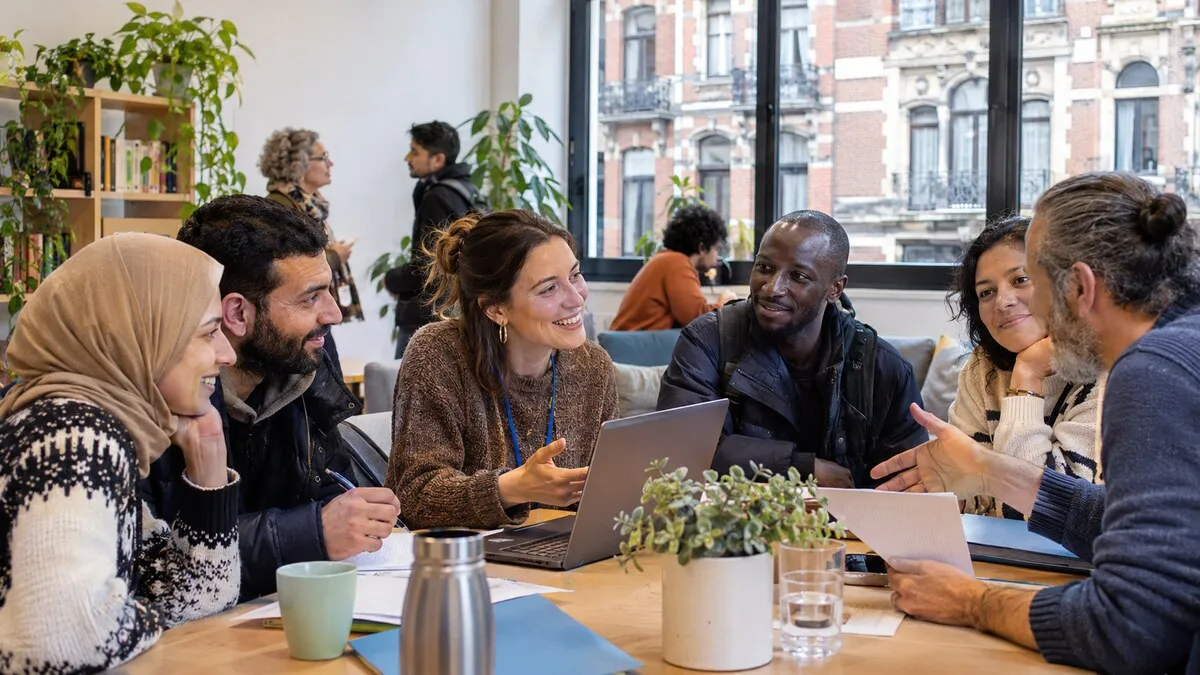
 Help for migrants
Organisations helping foreigners in Belgium: residence, asylum, family reunification, integration
CIRÉ, ADDE and SIREAS in Brussels, Point d'appui in Liège, Vluchtelingenwerk and the CAWs in Flanders, Caritas International for family reunification: who helps foreigners in Belgium for free, and where to turn for a lawyer or an integration programme.

Founder · Compatri, the social network for diasporas
Information checked on 2 November 2026.
In immediate danger, call 112 (ambulance, fire brigade) or 101 (police). For a question about your residence permit, asylum or family reunification, the leading organisations that help foreigners in Belgium are CIRÉ, ADDE and SIREAS in Brussels, Point d'appui in Liège, the Vluchtelingenwerk Vlaanderen Infolijn and the CAWs in Flanders, and Caritas International for family reunification. Myria, an independent federal public institution, answers questions on foreigners' rights free of charge. For a lawyer, the legal aid office (BAJ/BJB) of your judicial district can appoint one, free or at a reduced rate depending on your situation.
Are you homeless, ill or without a residence permit? Read our guide emergency help, shelter and healthcare without papers in Belgium first.
Compatri presents these organisations to point you in the right direction. It is linked to none of them and takes no steps on your behalf.
Who does what: the summary table
| Organisation | What it does | For whom | Where | Link |
|---|---|---|---|---|
| CIRÉ (association) | Reception, socio-legal drop-in sessions on residence and asylum, French school, housing | Any foreign national, with or without a residence permit | Brussels | cire.be |
| ADDE (association) | Residence, Social and private international law services (marriage, filiation, nationality), help for victims of domestic violence | Foreign nationals | Brussels | adde.be |
| SIREAS (association) | Social and legal service specialised in immigration law: residence, asylum, regularisation, family reunification, civil status | Anyone of foreign origin, with or without a residence permit | Brussels | sireas.be |
| Point d'appui (association) | Legal support for undocumented people in their applications for residence or protection | Undocumented people and families | Liège, by appointment | pointdappui.be |
| Vluchtelingenwerk Vlaanderen (association) | Infolijn: residence, reception, asylum procedure, temporary protection, social rights | People who have fled and those who help them | All of Belgium, by phone and chat | vluchtelingenwerk.be |
| Caritas International (association) | Family reunification support, unaccompanied minors, voluntary return | Migrants | Brussels and branches | caritasinternational.be |
| CAW (welfare centres) | Information and advice on residence and rights, psychosocial support, free | Everyone | Flanders | caw.be |
| Myria (public) | Free, confidential legal information on foreigners' rights | Everyone | Brussels, by phone and e-mail | myria.be |
| Legal aid office (public) | Appointment of a lawyer, free or at a reduced rate | Depending on income and situation | Each judicial district | justice.belgium.be |
| BAPA and BON (approved) | Free integration programme: support, citizenship, French or Dutch classes | Newcomers registered in a Brussels municipality | Brussels | bewelcome.brussels |
| Regional integration centres (approved) | Integration programme for newcomers | Foreign nationals in Wallonia | 8 Walloon centres | observatoireintegration.be |
| Immigration Office (public) | Administration that registers asylum applications and decides on many residence cases | - | Brussels | dofi.ibz.be |
| Fedasil (public) | Reception of applicants for international protection, voluntary return | Asylum seekers | All of Belgium | fedasil.be |
Drop-in hours change often, sometimes from one week to the next (closures during school holidays, for example). Always check the contact page before you go.
Right of residence: the organisations that help foreigners in Belgium
CIRÉ, in Brussels
CIRÉ runs a reception, information and referral service, and socio-legal drop-in sessions that help people, "with or without a residence permit", understand their rights regarding residence and asylum. Appointments are made during the phone hours or by e-mail. The association also runs a French school, a housing service and a work, equivalence and training service. In 2026 it is holding information sessions on immigration law.
ADDE, in Brussels
The Association pour le droit des étrangers (ADDE), not to be confused with French associations with a similar acronym, aims to promote the rights of foreign nationals. It brings together four services: Residence (family reunification, student residence, asylum, regularisation, detention), Social (social and medical aid, administrative steps), private international law (marriage, filiation, divorce, nationality) and AVEVI, for foreign victims of domestic violence, by appointment. Drop-in sessions need no appointment; new appointments are only given on site.
SIREAS, in Brussels
The SIREAS social and legal service describes itself as "a legal aid service specialised in immigration law". It deals with the right of residence, asylum and subsidiary protection, regularisation, family reunification and civil status, for "anyone of foreign origin, with or without a residence permit in Belgium". It offers on-site drop-in sessions and advice by phone.
Point d'appui, in Liège
Since 1996, Point d'appui has given legal support to undocumented people and families applying for a residence permit or international protection. The association sees people by appointment only. It celebrates its thirtieth anniversary in 2026.
In Flanders: the CAWs
The general welfare centres (CAW) answer questions about your residence, your rights and your future in Belgium: explaining procedures, the documents you need, referral to housing, healthcare or financial support, and help in coping with stress. Their help is free, professional and confidential, by e-mail, chat, phone or at a CAW house near you.
Asylum: applying for international protection
You apply in person at the Immigration Office, Rue Belliard 68, 1000 Brussels, as soon as possible after arrival. The Office registers the application, takes biometric data and determines which European state is responsible for examining it. Fedasil, the federal public agency, then organises reception: nearly a hundred centres in Belgium, run with its partners, including the Belgian Red Cross and Rode Kruis-Vlaanderen.
To understand the procedure:
- The Vluchtelingenwerk Vlaanderen Infolijn helps people who have fled and those around them (volunteers, host families, social workers): residence, reception, housing, school, work, social and medical rights, and legal questions on the asylum procedure and temporary protection. Line in Dutch, English and French on 02 225 44 11, a Ukrainian line, and chat via WhatsApp and Telegram: hours are on the Infolijn page.
- Caritas International supports unaccompanied foreign minors (guardianship), visits closed centres and helps vulnerable asylum seekers.
- CIRÉ, ADDE and SIREAS also deal with asylum in their drop-in sessions.
If reception is refused or delayed, you may end up on the street. Useful addresses are in our article emergency help and healthcare without papers in Belgium.
Family reunification
Caritas International points out that family reunification is a fundamental right. Its social service, with its partner CAP Brabantia, informs and supports families throughout the procedure, which it calls "complex, laborious and costly". ADDE's Residence service and SIREAS also handle these cases. Myria publishes a guide to family reunification support services.
The rules have recently been tightened. On 5 February 2026, twenty-five French- and Dutch-speaking organisations, including the Ligue des droits humains and Caritas International, asked the Constitutional Court to annul several provisions of the reform. Before taking any step, have your situation checked by one of these services: a rule read on a forum may already be out of date.
For what comes next, once your family has arrived, read family reunification in Belgium: what happens after arrival.
Getting a lawyer: second-line legal aid
Associations inform and refer; before the Council for Alien Law Litigation or a court, you often need a lawyer. The legal aid office (BAJ/BJB) of your district can appoint one, fully or partly free, depending on your income.
According to the FPS Justice, the following are presumed not to have sufficient means, and are entitled to fully free aid on presentation of supporting documents:
- the asylum seeker;
- the foreign national, only to lodge an application for regularisation of residence or an administrative or judicial appeal against a decision taken under the Act of 15 December 1980.
Other people are entitled to it according to an income ceiling, indexed every year. The legal aid office will tell you what applies to you.
Integration: the free programmes
In Brussels: BAPA and BON
After registering in a Brussels municipality (see registering your arrival with the municipality in Belgium), you can follow a free integration programme, in your language or one you understand: individual support, citizenship training, language classes and guidance towards work. Two networks run it:
- the BAPAs (reception offices for newcomers), approved by the Common Community Commission: VIA (Molenbeek and Schaerbeek), BAPA BXL and Convivial. They teach French;
- BON, approved by the Flemish Community, which teaches Dutch and runs free programmes in about twenty languages.
The programme is compulsory for some newcomers, depending on the reason for their stay. The official site bewelcome.brussels explains, in twelve languages, who is concerned, the exemptions and the penalties.
In Flanders: the Agentschap Integratie en Inburgering
The Flemish agency runs the civic integration programme (inburgering), the social orientation course, Dutch learning, recognition of foreign diplomas and social interpreters. Its legal helpdesk on immigration law and international family law is reserved for professionals: the agency states that it does not advise individuals. Ask your social worker to call it for you.
In Wallonia: the regional integration centres
Wallonia has eight regional integration centres (CRI), in Charleroi, La Louvière, Saint-Ghislain, Namur, Liège, Verviers, Libramont and Nivelles. They support newcomers in their integration programme. The Observatoire wallon de l'intégration publishes the contact details of each CRI and the area it covers.
Public bodies: what they do, and what they don't
- Myria, the Federal Migration Centre, is an independent public institution. It provides information "free of charge and in complete confidentiality" on the rights and obligations of foreigners (family reunification, free movement, return), through its free legal line 0800 14 912 or by e-mail. Myria does not provide lawyers, does not follow procedures for you and does not help fill in residence or visa applications.
- The Immigration Office is the administration that decides. Its website explains the procedures (studies, family reunification, residence authorisations 9bis and 9ter); it does not advise you on your strategy.
- Fedasil manages the reception of asylum seekers and the voluntary return programme.
- The Ligue des droits humains defends collective causes before the courts and Parliament. For individual help, it refers to its directory.
Beware of scams
Before you pay anyone, remember this.
- A serious association never promises a residence permit, nor a deadline. Only the administration decides.
- Information from the associations listed here and from Myria costs nothing. Be wary of "immigration consultants" who ask for money to fill in a form.
- A lawyer must be registered with a Belgian bar. Check this with the Bar Association of your district, and ask the legal aid office whether you are entitled to legal aid.
- Never hand the original of your passport to an intermediary. Keep a copy of every document you hand over, and proof of every submission.
Scams also target housing: our guide on housing discrimination helps you recognise illegal practices.
Your compatriots, the other network
An association answers a legal question. For the rest (a first roof, a step at the municipality, an appointment you must not miss), those who went through the same thing before you are often the most useful. On Compatri, join your country's community in your city: Congolese in Belgium, Cameroonians in Belgium, Guineans in Belgium, and all communities in Belgium. The associations directory also lists diaspora associations in Belgium, and our article on mutual help between compatriots shows how to ask for and offer help.
For the overview by visa, read arriving in Belgium with a D visa. Organisations in other countries are gathered in our guide organisations helping foreigners in Europe and the Americas, and those of the neighbouring country in organisations helping foreigners in Luxembourg.
Sources
- CIRÉ: reception and socio-legal drop-in sessions
- ADDE: services and drop-in sessions
- SIREAS: social and legal service
- Point d'appui (Liège)
- Vluchtelingenwerk Vlaanderen: Infolijn
- Caritas International: help for migrants
- Caritas International: family reunification
- CAW: migration
- Myria: contact and legal line
- FPS Justice: second-line legal aid
- Immigration Office: application for international protection
- Fedasil: reception of asylum seekers
- Integration programme in Brussels (BON and BAPA)
- VIA, reception office for newcomers
- BAPA BXL
- Convivial
- BON, Brussels civic integration office
- Agentschap Integratie en Inburgering: legal services
- Observatoire wallon de l'intégration: CRI contact details
- Ligue des droits humains
- 112.be: emergency numbers
Frequently asked questions
Where can a foreigner find free legal help in Belgium?
For information, Myria answers free of charge through its legal line and by e-mail, and associations such as CIRÉ, ADDE, SIREAS (Brussels), Point d'appui (Liège) or the Vluchtelingenwerk Vlaanderen Infolijn hold drop-in sessions. For a lawyer, go to the legal aid office of your district: according to the FPS Justice, asylum seekers, and foreign nationals for a regularisation application or an appeal, are presumed entitled to fully free aid.
Which organisation helps with family reunification in Belgium?
Caritas International's social service, with its partner CAP Brabantia, supports families throughout the procedure. ADDE's Residence service and SIREAS's legal service, in Brussels, also handle these cases, and Myria publishes a guide to family reunification support services. The rules have recently been tightened: have your situation checked before taking any step.
Where do you apply for asylum in Belgium?
In person at the Immigration Office, Rue Belliard 68, 1000 Brussels, as soon as possible after arrival (at the border, with the border control authorities). The Office registers the application, then Fedasil organises reception. To understand the procedure, the Vluchtelingenwerk Vlaanderen Infolijn answers in Dutch, English and French, and CIRÉ, ADDE and SIREAS hold drop-in sessions in Brussels.
Is the integration programme compulsory in Brussels?
For some newcomers, yes, depending on the reason for their stay. It is free and is followed at a BAPA (VIA, BAPA BXL, Convivial) for French or at BON for Dutch, after registering in a Brussels municipality. The official site bewelcome.brussels explains, in twelve languages, who is concerned, the exemptions and the penalties.
Can an association get me a residence permit?
No. Only the administration (the Immigration Office, and for asylum the asylum authorities) decides. An association informs you, helps put the file together and refers you to a lawyer. Be wary of anyone who promises a permit or a deadline for money, and check that a lawyer is registered with a Belgian bar.