 Help for migrants
Homeless foreigner in France: 115, emergency accommodation and the associations that help
No accommodation and no money in France, with or without papers: 115, day centres, domiciliation at the CCAS, the associations (Emmaüs Solidarité, Secours populaire, Secours Catholique, Red Cross, Restos du Cœur, Utopia 56, Dom'Asile, Salvation Army) and protection for unaccompanied minors.

Founder · Compatri, the social network for diasporas
Information checked on 2 November 2026.
You are in France with no accommodation and no money, with or without papers: call 115. It is the free emergency accommodation number, available 24 hours a day, 7 days a week, from a landline or a mobile, even with no credit. Emergency accommodation is open to everyone, regardless of nationality or administrative status, according to the French Ministry for the Ecological Transition. During the day, day centres (accueils de jour) offer a shower, a meal and a social worker. To receive your mail and open your rights, ask for a domiciliation (postal address) at your town's CCAS or at an approved association.
Immediate danger: 15 (Samu), 17 (police), 18 (fire brigade) or 112.
This page covers emergency help and accommodation for foreigners in France: what each association does, for whom, where, and the link to find it. It points you in the right direction; it does not replace a social worker. It is part of our series on associations helping migrants in Europe and the Americas.
In short: who does what
| Organisation | What it does | For whom | Where | Link |
|---|---|---|---|---|
| 115 (public) | Emergency accommodation, listening, referral | Anyone without shelter | All of France | Dial 115 |
| Town CCAS (public) | Domiciliation, social assistance | People without a stable home who have a link with the town | Every town | Town hall |
| Emmaüs Solidarité | Street outreach, day centres, night shelters, accommodation | People and families on the street | Paris and Île-de-France | emmaus-solidarite.org/etre-aide |
| Secours populaire | Food and material aid, access to rights, health | Anyone in distress, unconditional welcome | All of France | secourspopulaire.fr |
| Secours Catholique | Welcome, emergency aid, access to rights, French classes | People in poverty, including migrants | All of France | secours-catholique.org |
| French Red Cross | Samu social, emergency social aid, paperwork help, family links, listening line | Anyone, whatever their status | All of France | croix-rouge.fr/annuaire |
| Restos du Cœur | Free food aid, hot meals, street outreach | People with insufficient income; hot meals with no conditions | All of France | restosducoeur.org |
| Utopia 56 | Street outreach, citizen hosting, help for unaccompanied minors | Exiled people, families on the street, unaccompanied minors | Paris, Calais, Grande-Synthe, Lille, Rennes, Toulouse, Tours | utopia56.org |
| Dom'Asile | Domiciliation and access to social rights | Asylum seekers, refugees, rejected applicants | Île-de-France | domasile.org |
| Salvation Army Foundation | Emergency accommodation, day centres, domiciliation, unaccompanied minors | People in poverty, exiled people | Over 200 establishments in France | armeedusalut.fr/etablissements |
115: the first number to call
115 is the emergency social helpline. The call is free, anonymous, and possible from a mobile with no credit. Call handlers look for a place for the night and refer you to suitable facilities: emergency accommodation centres (CHU), accommodation and social reintegration centres (CHRS), hotel nights.
What to know before calling:
- The line is often saturated, especially in the evening and in winter. Call again. Call early in the day if you can.
- Your administrative situation does not exclude you. Emergency accommodation is open regardless of nationality or administrative status.
- Give the useful information: where you are, whether you are with children, pregnant, ill or elderly. It matters for the referral.
- You can report another person sleeping rough. In Paris, the Samusocial also has an online reporting form. Outside Paris, the département's integrated reception and referral service (SIAO) handles it.
115 does not replace medical emergencies. Someone ill or injured: 15. Danger: 17 or 112.
Day centres: rest, wash, see a social worker
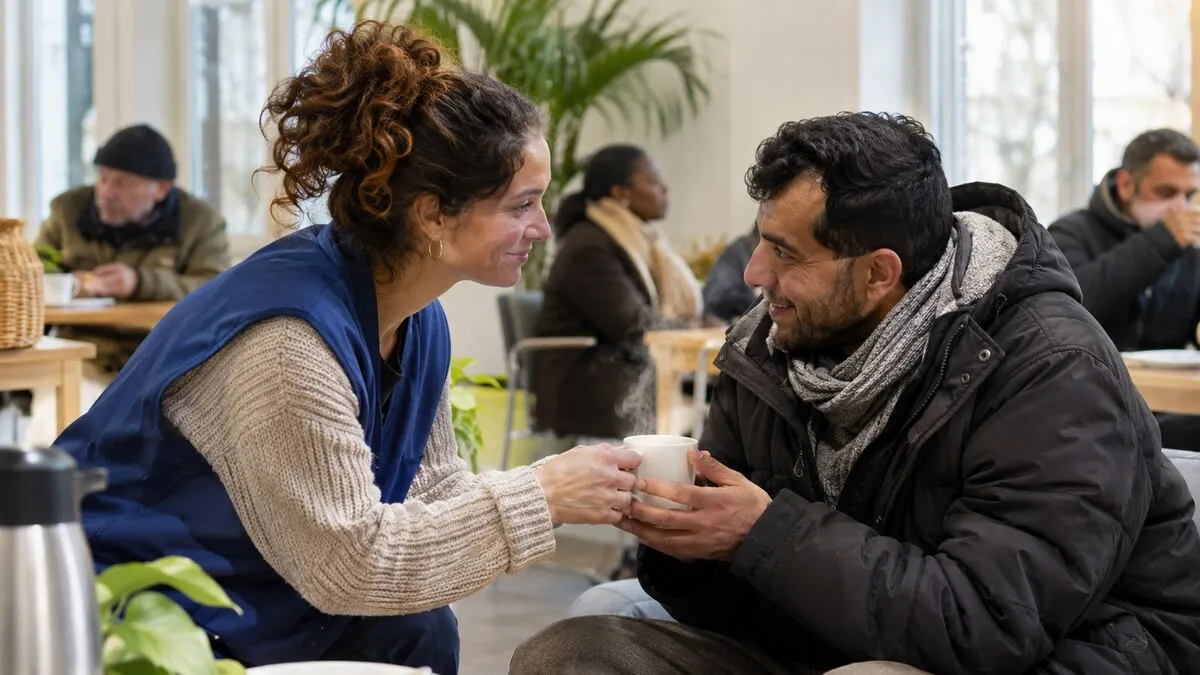
A day centre is a place where a person living on the street can rest, take a shower, wash clothes, eat and meet a social worker. Access to rights often starts there: domiciliation, health cover applications, referral to accommodation.
They are run by associations (Emmaüs Solidarité, Salvation Army, Red Cross, Secours Catholique and others) and by towns. Their opening hours change often: ask 115, the town hall or the CCAS for the nearest one, or check each association's page.
Associations that help foreigners on the street
Emmaüs Solidarité (Paris and Île-de-France)
Emmaüs Solidarité fights « without conditions » against the exclusion of people and families living on the street. It runs street outreach, day centres and night shelters, distributes food aid and manages accommodation. Its Paris day centres receive different groups (women, men, families); one of them is for newcomers and asylum seekers on the street. List and target groups on the Être aidé page.
Secours populaire français
Present throughout France through its departmental federations and local committees, the Secours populaire offers an unconditional welcome to anyone in distress. It provides food and material aid, access to rights and access to care, and counts migrants and refugees among its actions. Find the nearest committee on the Où nous trouver map.
Secours Catholique (Caritas France)
The Secours Catholique welcomes people in poverty whatever their culture and beliefs. For migrants, it offers drop-in places, help with paperwork (asylum applications, benefits), French classes and psychological support. Its 72 regional offices are listed on the Nos implantations page.
French Red Cross
The Red Cross says it is the leading Samu social operator in France. Its teams commit to an unconditional welcome, refer people to its social grocery shops, clothing shops, French classes and accommodation, and help with administrative files (asylum, family reunification, domiciliation). Two national services are worth knowing:
- restoring family links, free and confidential, to find a relative in France or abroad, whatever your status in France;
- psychosocial support by phone on 0 800 858 858, free and anonymous, open to everyone.
Local addresses are in the Red Cross directory.
Restos du Cœur
Food aid from the Restos du Cœur is free. To receive food parcels, you register each year at a centre, showing income below that year's scale. Hot meals and street outreach, meant for emergencies, are not subject to any income condition. Centres can be found via the departmental associations page.
Utopia 56
Utopia 56 helps exiled people and anyone in distress: night outreach, distribution of food, clothes and tents, citizen hosting with private individuals, French classes. The association has branches in Paris, Calais, Grande-Synthe, Lille, Rennes, Toulouse and Tours. In Paris, it runs a desk for families, women alone and couples with nowhere to sleep. Contact: contact page and each branch's page on utopia56.org.
Salvation Army Foundation
The Fondation de l'Armée du Salut runs over 200 establishments in 28 départements. Its directory can be filtered by service: emergency accommodation, day centre and domiciliation, unaccompanied foreign minors. It also lists places for exiled people. See the establishments.
Domiciliation: an address to open your rights
Without an address, you cannot receive letters from the préfecture, the CPAM or a court. Domiciliation (élection de domicile) gives an administrative address to a person without a stable home: on the street, in emergency accommodation, or temporarily staying with someone.
The general system (public). Service-public describes the procedure:
- you apply to the CCAS (municipal social action centre) or an approved organisation; the town hall tells you which ones exist;
- you need a link with the town: living, working or being supported there, having family there, or having a child at school there;
- an interview is compulsory; the decision is in writing, within two months, and a refusal must give reasons;
- domiciliation lasts one year, renewable; you must check in at least once every three months.
For homeless people applying for state medical aid (AME), service-public states that they can take a legal address at a CCAS or an approved association. Healthcare is covered in our article on access to healthcare for foreigners in France.
Asylum seekers have a separate system, set out in the code on the entry and residence of foreigners. See our guide to associations that help you claim asylum in France.
Dom'Asile (Île-de-France) is dedicated to domiciliation and access to social rights for exiled people without stable housing: asylum seekers, recently recognised refugees, rejected applicants who cannot get domiciliation elsewhere. No document is required to register. The association first checks whether a public body (CCAS, asylum seekers' platform) can provide domiciliation. Its centres cover seven départements of Île-de-France: centres and desks, and the steps on being domiciled at Dom'Asile.
Unaccompanied foreign minors: the département protects
A young foreigner under 18, alone in France, falls under child protection. The Ministry of Solidarity states it plainly: anyone presenting as an unaccompanied minor is taken in by the services of the département, that is, child welfare (aide sociale à l'enfance, ASE).
The steps described by the ministry:
What to do: go to the departmental council or the ASE services where you are. The 115 and associations also refer young people. Do not stay alone during the assessment, especially if refused: Utopia 56 supports unaccompanied minors (French classes, outreach, accompaniment), the Red Cross runs dedicated facilities, and the Salvation Army Foundation has establishments for unaccompanied foreign minors.
Beware of scams
Distress attracts crooks. A few simple rules:
- 115, domiciliation at the CCAS and food aid from associations are free. Nobody should make you pay for a shelter place or a domiciliation certificate.
- Be wary of paid intermediaries promising housing, a préfecture appointment or a « fast-track file ».
- A lawyer is registered with a bar. Ask which one and check. Someone calling themselves a « legal expert » without proof should not touch your file.
- A serious association never promises a residence permit. It explains, refers, supports. For residence itself, see our guide to associations that help you get a residence permit.
- Never hand the original of your passport to a stranger.
Find your compatriots
An association gives a meal and an address. Compatriots give something else: someone who speaks your language, knows the neighbourhood, knows which day centre is welcoming and which desk answers. On Compatri, find the community from your country in your city and the diaspora pages, such as Senegalese in France, Cameroonians in France or Ivorians in France. The associations directory also lists diaspora associations. Our article on mutual aid between compatriots shows what a community can do, and what it cannot replace.
Compatri is not linked to any of the associations mentioned: we present them to help you find your way. Once your situation is stable, residence procedures resume: see renewing your residence permit in France.
Sources
- Ministry for the Ecological Transition: emergency accommodation
- Mon Parcours Handicap: finding emergency accommodation
- Samusocial de Paris: report a person on the street
- Service-public: domiciliation for a person without a stable home
- Service-public: state medical aid
- Ministry of Solidarity: caring for unaccompanied minors
- Emmaüs Solidarité: getting help
- Secours populaire: where to find us
- Secours Catholique: migrants
- Secours Catholique: locations
- French Red Cross: emergency social aid
- French Red Cross: restoring family links
- French Red Cross: psychosocial support by phone
- Restos du Cœur: food aid
- Utopia 56 and Utopia 56 Paris
- Dom'Asile: being domiciled
- Salvation Army Foundation: establishments
Frequently asked questions
Can you call 115 without papers?
Yes. 115 is free, anonymous and available 24 hours a day, even from a mobile with no credit. The Ministry for the Ecological Transition states that emergency accommodation is open to everyone, regardless of nationality or administrative status. The line is often saturated: call again, and call early in the day if possible.
How do you get an address when you are homeless in France?
Through domiciliation. According to service-public, you apply to the town's CCAS or to an approved organisation, provided you have a link with the town. An interview is compulsory, the decision comes within two months, and domiciliation lasts one year, renewable. In Île-de-France, Dom'Asile provides domiciliation to asylum seekers, refugees and rejected applicants who cannot get it elsewhere.
Where can you eat for free in France when you have no money?
Day centres often serve a meal. The Restos du Cœur give free food aid: parcels require yearly registration with an income condition, but hot meals and street outreach have no income condition. The Secours populaire, the Secours Catholique and the Red Cross also provide food aid; their websites show the nearest branch.
What should you do if you are a foreign minor alone in France?
Go to the departmental council or the child welfare services (ASE) where you are. The Ministry of Solidarity states that anyone presenting as an unaccompanied minor is taken in by the département: emergency shelter, assessment of minority and isolation, then care if minority is recognised. Utopia 56, the Red Cross and the Salvation Army Foundation also support minors.
Can an association make me pay for accommodation or domiciliation?
115 is free, and nobody should make you pay for an emergency shelter place or a domiciliation certificate. Be wary of intermediaries promising housing, a préfecture appointment or a residence permit for money: a serious association never promises a residence permit, and a lawyer is always registered with a bar, which you can check.