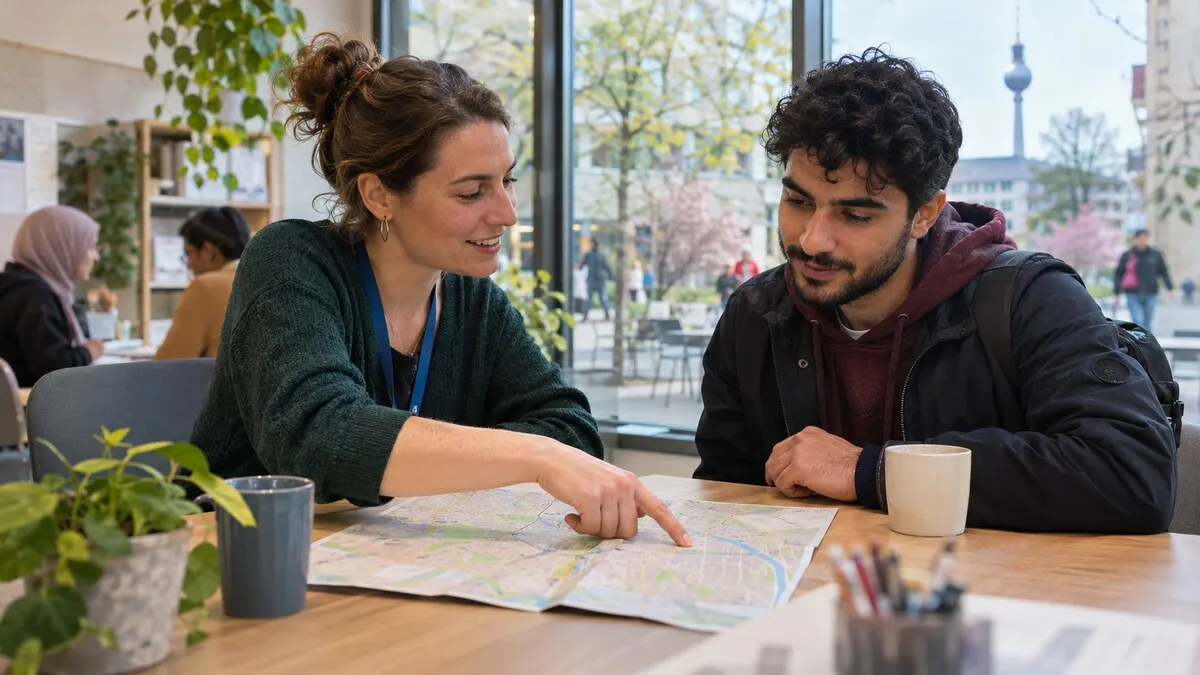
 Help for migrants
Organisations helping foreigners in Germany: Migrationsberatung, Pro Asyl, Caritas, Diakonie, Red Cross
Who helps foreigners in Germany free of charge: the Migrationsberatung (MBE) and Youth Migration Services, Pro Asyl and the Refugee Councils, Caritas, Diakonie, the German Red Cross, AWO, Paritätischer, Refugee Law Clinics and Medibüros for healthcare without papers.

Founder · Compatri, the social network for diasporas
Information checked on 2 November 2026.
You are a foreigner in Germany and need free help with a residence permit, an asylum application, healthcare without insurance or simply to understand a letter from the authorities. The first port of call is the Migrationsberatung: free advice, funded by the federal government and provided by the big welfare organisations (Caritas, Diakonie, German Red Cross, AWO, Paritätischer). For asylum, the leading organisations helping foreigners in Germany are Pro Asyl and the Refugee Councils (Flüchtlingsräte) of each federal state. This guide tells you who does what, for whom, and where to find the right office.
In an emergency: 112 for the rescue service (Rettungsdienst) and the fire brigade. For a health problem that is not life-threatening, 116117 reaches the on-call medical service, free of charge, day and night. Women facing violence can call the Hilfetelefon on 116 016: free, anonymous, 24 hours a day, with advisers in 18 languages.
Organisations helping foreigners in Germany: the overview
| Organisation | What it does | For whom | Where | Link |
|---|---|---|---|---|
| Migrationsberatung für erwachsene Zugewanderte (MBE) | Free advice: language, work, housing, health, family, letters from the authorities | Adult immigrants | Over 1,200 offices, and online | migrationsberatung.org |
| Jugendmigrationsdienste (JMD) | Support into school, training, work | Young people aged 12 to 27 | About 500 offices, and online | jugendmigrationsdienste.de |
| Pro Asyl | Individual advice on asylum and residence law, by email | Refugees, people facing deportation, their supporters | All of Germany (remote) | proasyl.de |
| Flüchtlingsräte | Information, directories of local advice centres, sometimes advice | Refugees and volunteers in the state | One per federal state | List at Pro Asyl |
| Caritas | Migrationsberatung, free and confidential online advice | Any immigrant | All of Germany | caritas.de |
| Diakonie | Migration services, search for a centre nearby | Any immigrant | All of Germany | diakonie.de |
| Deutsches Rotes Kreuz (DRK) | MBE, JMD, Suchdienst (tracing relatives) | Immigrants, separated families | All of Germany | drk.de |
| Refugee Law Clinics | Free legal advice from supervised law students | People in need, refugees, migrants | About 38 university cities | refugeelawclinics.de |
| Medibüro, Medinetz | Anonymous, free referral to a doctor | People without papers or insurance | Berlin, Leipzig and other cities | medibuero.de |
None of these organisations issues a residence permit: the Ausländerbehörde (foreigners' office) of your city decides, and for asylum the Federal Office for Migration and Refugees (BAMF).
The first port of call: the Migrationsberatung (MBE)
The Migrationsberatung für erwachsene Zugewanderte is a programme funded by the federal government and run by the BAMF. The BAMF describes it as always free of charge; its shared website calls it independent and confidential. It helps with learning German, school and work, housing, health, marriage and family, and letters from the authorities.
Seven organisations run it: AWO, Caritas, Diakonie, Der Paritätische, the German Red Cross (DRK), the Zentralwohlfahrtsstelle der Juden (ZWST) and the Bund der Vertriebenen. In 2025 the programme had 1,227 advice locations. To find yours, the BAMF points to its BAMF-NAvI search tool. If no office is nearby, the online service mbeon (app and website) answers by chat.
Young people aged 12 to 27 have their own network, the Jugendmigrationsdienste (JMD, Youth Migration Services). Funded by the Federal Family Ministry, they mainly support the move from school to work. Their website has a map of the roughly 480 to 500 offices and an online service, jmd4you.
For the settling-in steps themselves (Anmeldung, residence permit, health insurance), read our guide arriving in Germany: Anmeldung within 14 days, residence permit, health insurance.
Asylum and residence law: Pro Asyl and the Refugee Councils
Pro Asyl is the national organisation defending refugees. Its individual advice, funded by donations, is for people in the asylum procedure and people with residence-law problems (threatened deportation, family reunification, the right to stay), and for their supporters. It works by email, in German or English; Pro Asyl states that no in-person advice is given at its office. Where needed, Pro Asyl refers you to a specialised centre or helps you find a lawyer. For an urgent case needing a lawyer you cannot pay, the application to Pro Asyl's legal aid fund goes through the Refugee Council of your federal state.
The Flüchtlingsräte are associations, one per federal state. Their role varies: Bavaria's gives legal advice, while those of Berlin and North Rhine-Westphalia do not handle individual cases and point to directories of local centres. Pro Asyl gathers the link for every state on a single page: it is the simplest starting point to find a centre near you.
Independent asylum procedure advice is under threat. Welfare organisations currently provide free Asylverfahrensberatung, independent of the authorities. AWO writes, on 19 October 2026, that under current budget plans this advice will not continue in its present form from 2027. Check with your local office what remains open.
Refugee Law Clinics complete the picture. Students, mostly of law, give free individual legal advice there, under the supervision of qualified lawyers. They exist in about 38 university cities, including Berlin, Hamburg, Munich, Cologne, Frankfurt, Leipzig and Dresden. Their help page warns that matching for individual advice can take up to a month.
The big welfare organisations
- Caritas: besides the MBE, Caritas offers online advice for migrants and refugees, "individual, confidential and free". You can stay anonymous, without an email address; the answer usually arrives within two working days. Information pages exist in about twenty languages, but personal advice is generally given in German.
- Diakonie: the Protestant welfare organisation supports immigrants "with all the questions of their new situation" and refers to the Migrationsberatung. Its website offers a search for centres by postcode and online advice.
- Deutsches Rotes Kreuz (DRK): the German Red Cross provides the MBE in 105 of its local branches (figure from September 2024), JMDs and the Suchdienst, described below.
- AWO (Arbeiterwohlfahrt): AWO advises and supports immigrants through its regional and local associations. For an office nearby, contact the AWO of your state or city.
- Der Paritätische: an umbrella of more than 10,000 member organisations, it coordinates about a hundred MBE offices. Many migrant organisations are members.
Healthcare without papers or insurance
If you have neither a residence permit nor health insurance, the Medibüros and Medinetze refer you to a doctor, anonymously and free of charge. They are volunteer networks, city by city.
- Medibüro Berlin describes itself as a network for the right to healthcare for all migrants. It first refers people to the Clearingstelle of the Berliner Stadtmission, for those who have lived in Germany for at least six months: it covers treatment costs without passing data to the authorities. If the Clearingstelle cannot help, the Medibüro takes over.
- Medinetz Leipzig arranges free and anonymous care, regardless of residence status or insurance.
Other cities have their own Medibüro or Medinetz. Search for "Medinetz" or "Medibüro" followed by your city's name, and check on the group's website that it is still active. In a life-threatening emergency, call 112 straight away.
A separated family: the Red Cross Suchdienst
The DRK-Suchdienst helps people separated from relatives by war, disaster, flight or migration: it searches for family members, restores contact and advises refugees on family reunification procedures. It works with Red Cross societies worldwide and the ICRC.
For family reunification from France or Belgium, compare with our overview of organisations helping foreigners in Europe and the Americas.
Beware of paid intermediaries
Watch out for scams. A serious organisation never promises a residence permit or asylum: the decision belongs to the Ausländerbehörde or the BAMF. Be wary of anyone who asks for money to get an appointment, guarantees a result or calls themselves a lawyer without being registered with a bar (Rechtsanwaltskammer). The Migrationsberatung, the Refugee Law Clinics and the Medibüros are free. If in doubt, ask the MBE or your state's Refugee Council.
Finding your compatriots in Germany
An organisation solves a problem. Your compatriots help you with daily life: which office, which neighbourhood, which doctor speaks your language. On Compatri, the Germany page brings together cities and meetups, for example Berlin and Munich. Diaspora pages, such as Cameroonians in Germany or Moroccans in Germany, lead to the communities. The associations directory lists diaspora associations, and our article on mutual help between compatriots explains how to ask for and offer help.
Compatri is not linked to any of the organisations mentioned and does not carry out any procedure for you. Studying? Our guide studying in Germany from Africa covers the blocked account and admission. See also our guides for Switzerland and Austria.
Sources
- BAMF: advice for adults (Migrationsberatung)
- Migrationsberatung für erwachsene Zugewanderte (shared website)
- Der Paritätische: MBE
- Jugendmigrationsdienste
- Pro Asyl: individual advice
- Pro Asyl: local advice centres by state
- Flüchtlingsrat NRW
- AWO: announced end of the Asylverfahrensberatung (19 October 2026)
- Caritas: online migration advice
- Diakonie: flight and migration
- DRK: migration, integration and participation
- DRK: Suchdienst
- Refugee Law Clinics: the concept
- Refugee Law Clinics: locations
- Medibüro Berlin
- Medinetz Leipzig
- 116117: on-call medical service
- Hilfetelefon Gewalt gegen Frauen
Frequently asked questions
Where can foreigners get free advice in Germany?
The Migrationsberatung für erwachsene Zugewanderte (MBE) is free according to the BAMF. It is provided by AWO, Caritas, Diakonie, Der Paritätische, the German Red Cross, ZWST and the Bund der Vertriebenen, in more than 1,200 locations. You find the nearest office with the BAMF-NAvI search tool, or write online via mbeon. Young people aged 12 to 27 turn to the Jugendmigrationsdienste.
How do I contact Pro Asyl for asylum advice?
Pro Asyl gives individual advice by email, in German or English, to people in the asylum procedure or with residence-law problems. There is no in-person advice at its office. Pro Asyl refers you to a local centre or a lawyer where needed; for its legal aid fund, the application goes through the state's Refugee Council.
Where can I get medical care without papers in Germany?
Medibüros and Medinetze, volunteer networks in several cities, refer people to doctors anonymously and free of charge. In Berlin, the Medibüro first refers you to the Clearingstelle of the Berliner Stadtmission, for those who have lived in Germany for at least six months. In a life-threatening emergency, call 112.
What is a Refugee Law Clinic?
It is a group of students, mostly of law, giving free individual legal advice to people in need, refugees and migrants, under the supervision of qualified lawyers. They exist in about 38 German university cities. Matching can take up to a month.
Can an organisation get me a residence permit in Germany?
No. The residence permit is decided by the Ausländerbehörde, and asylum by the BAMF. An organisation informs you, helps you prepare a file or find a lawyer, but never guarantees a result. Anyone promising a permit for money should alarm you.