 Passport
The Compatri number: the +999 code, the country code and how far it reaches
Every member gets a number that looks like an international phone number without being one. Here is what its fourteen digits contain, why the code is +999, and what the number actually lets you do.

Founder · Compatri, the social network for diasporas
On Compatri, every member gets a number. It looks like an international phone number, it is written like one, it even shows up like one on your call screen when someone rings you. And yet it isn't one. It is the number of the Compatri Passport: a diaspora identity, portable, that depends on no operator.
Here is what it contains, where the +999 code comes from, and how far it reaches.
Anatomy of a Compatri number
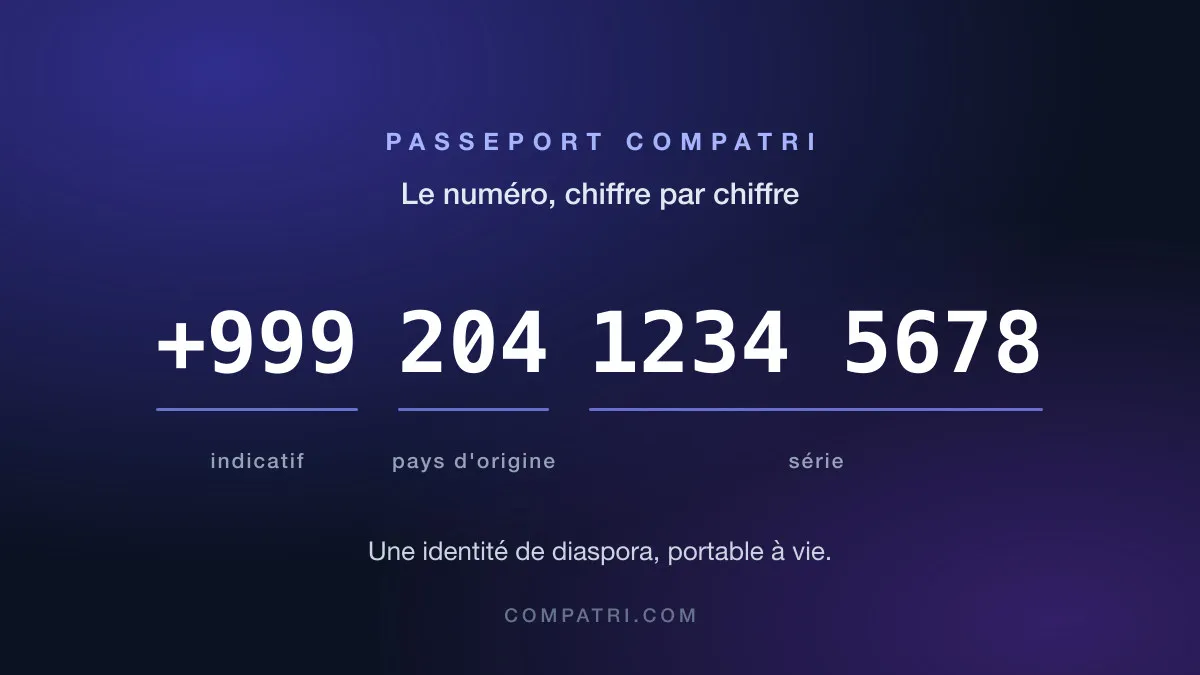
A Compatri number is written like this: +999 204 1234 5678
Fourteen digits, three blocks, each with a precise role.
| Block | Example | What it says |
|---|---|---|
| Code | 999 | Belonging to Compatri, shared by every member |
| Country code | 204 | The country of origin, here Benin |
| Serial | 1234 5678 | You, and no one else |
Nothing more. No date of birth, no city, no year of joining. An identity number has no business telling your life story to whoever reads it over your shoulder.
The +999 code: a country on no map
Telephone codes say where you are calling from: +33 France, +229 Benin, +32 Belgium. The diaspora has no code, for a simple reason: it has no territory. It is everywhere at once.
The +999 is that missing code. It doesn't designate a country, it designates a belonging: that of people who live away from home and keep a link with the country they come from.
One important point, and it deserves to be said plainly: this is not a phone number. You don't dial it on a mobile keypad, no operator routes it, there is no SIM card, no plan and no roaming behind it. It lives on the internet, inside the app. That is exactly what lets it work identically in Brussels, in Cotonou or in Montreal: unchanged, at no cost, with no telecom network.
The country code: where you're from, not where you are
The second block is nothing homemade. It is the numeric ISO 3166-1 code, the worldwide standard found in official passports themselves: 204 Benin, 120 Cameroon, 686 Senegal, 384 Ivory Coast, 250 France, 056 Belgium, 504 Morocco. One hundred and sixty-one countries are covered today.
Reusing an existing standard isn't a technical detail, it is what makes a number readable: one glance at the middle block and you know which diaspora the caller comes from.
And above all, this block states the country of origin, never the country of residence. The consequence is the one that matters most day to day: your number doesn't change when you move. You go from Paris to Montreal, from Brussels to London, you change operator, SIM card and address, the number stays the same. It is an anchor point that survives relocations, where a phone number dies with each one.
The serial: eight digits, drawn at random
The last block holds eight digits, meaning a hundred million possible numbers per country of origin. Generous, and deliberately so: a shorter serial would have saturated long before covering a large diaspora.
Those eight digits are not handed out in order. The first Beninese member did not get 0000 0001, nor the second 0000 0002. Every serial is drawn at random, and that answers a very concrete risk: a predictable number can be guessed. One program and a few hours would be enough to walk an entire range, discover every member of a country and canvass them one by one. Sequential numbering would have handed a complete directory to anyone who can count.
Finally, some serials are never drawn. Repetitions (1111 1111), round numbers, palindromes, runs (1234 5678) and alternating patterns are set aside, a little like standout licence plates. They don't land on someone by chance: they will be offered later, separately.
The reach: how far this number goes
A number is only worth what it opens. This one serves four purposes.
Receiving calls. Audio and video calls between members, one to one as well as in groups, run through the number. Your phone rings as it would for an ordinary call, call screen included, and it is the caller's Compatri number that appears instead of a personal one. The call log keeps it, so calling back is a single tap.
Being reachable without giving out your details. That is the whole point of the system. You give neither your phone number nor your email address to someone you barely know yet: you give your Compatri number. If things go wrong, you cut the link inside the app, and you have nothing else to change, no SIM card, no address.
Introducing yourself. The number appears on both editions of the passport, which are two layouts of one and the same number: the National edition, in card format, and the International edition, a booklet whose identity page reproduces even the strip of characters found at the bottom of real passports. Next to the number, a QR points to your profile, which nicely replaces swapping contacts at the end of an event.
Lasting. The number is issued once, and it is for life. The document itself is valid for ten years, like an ordinary passport.
And here is what it doesn't do, just as clearly: it neither calls nor receives numbers on the ordinary telephone network, it replaces no official identity document and carries no administrative value. It is a network identity, not a state document.
Getting yours, and keeping it
Two pieces of information are enough, but both are indispensable: your country of origin, which supplies the middle code, and your city of residence. A passport attests to a "from here, settled there": without both halves, there is no document to issue.
Issuing is immediate. Then comes a deadline: you have thirty days to get your identity verified. Two documents are requested, because they don't prove the same thing, an identity document from the country of origin that says who you are, and proof of residence that says where you live. Past that deadline without verification, the document is deactivated. The number stays yours: getting verified later reactivates it, unchanged.
Lastly, the passport carries a grade that simply follows your plan: Standard for the free plan, Service for Starter, Diplomatic for Advanced. That grade says what your account allows, it says nothing about your trustworthiness. That role belongs to the verified member badge, which is obtained only through identity verification and cannot be bought.
What the number changes, concretely
Read a Compatri number and you know two things: that the person is part of the network, and which diaspora they come from. Give out yours and you become reachable without having exposed yourself. Move house, and you stay reachable exactly as before.
Few digits for many journeys. And that is precisely what we ask of a number: to stay put, while life doesn't.
Frequently asked questions
Is the Compatri number a real phone number?
No. It has the shape of one (+999 204 1234 5678) and appears as a caller ID on the call screen, but no operator routes it: there is no SIM card, plan or roaming behind it. Calls and messages travel over the internet, inside the app, which is what lets it work identically in any country, at no cost.
What do the middle digits, like 204 or 250, mean?
It is the numeric ISO 3166-1 code of your country of origin, the international standard used in official passports themselves: 204 for Benin, 120 for Cameroon, 686 for Senegal, 250 for France. It always indicates the country of origin, never the country of residence, which is why the number stays identical after a move.
Can I choose my Compatri number?
Not at sign-up: the eight-digit serial is drawn at random, precisely so that a number cannot be guessed and no one can walk through an entire diaspora by counting. Standout serials (repetitions, round numbers, palindromes, runs) are never assigned at random; they are set aside to be offered separately later on.
What happens if I don't get my identity verified within thirty days?
The document is deactivated, but the number remains yours: it is never reassigned to someone else. Simply send the two requested documents (an identity document from your country of origin and proof of residence) and the passport becomes active again, with exactly the same number.
Do you have to pay to get a Compatri number?
No. The number and the Standard passport are included in the free plan, along with calls and messaging between members. Paid plans change the passport grade (Service, Diplomatic) and extend the discovery radius, groups or the relayed address, but the number itself is the same for everyone and cannot be bought.